Scripture Reading: Exodus 4:18-31
The mystery of the Hebrew Bible is that it was likely shaped by several different sources that were later edited together.
As the different people told stories about their spiritual ancestors such as Moses, we can also see odd tribal stories that may have equally odd beliefs about God.
Verses 24-26 of today's reading certainly fit this bill.
Why on earth would God want to kill Moses? After his son is circumcised, this seems to appease God. It could be that Moses needs to connect his own family with the captive people that God is sending him to free.
After all, Moses was raised as an Egyptian and then went to live as a Midianite, even marrying into the family of a Midianite priest.
The circumcision could have been a message to God's people as much as a devotion to God.
With this act, Zipporah, the wife of Moses, a Midianite, could be stating, we are Hebrews just like you.
Standing with others in their need can be a powerful act.
Can you see how solidarity with those who are suffering can be an act of faith?
Think about someone that you've stood by in their time of trouble. Think about how this might have changed their lives. Can you see how God is a part of this?
As a United Methodist, John Wesley's understanding of Preceding or Prevenient Grace influences my theology and these posts. This is the grace of God that reaches out to us before we are aware of it.
Sunday, February 14, 2016
Saturday, February 13, 2016
Daily Devotion for Day 4 of Lent 2016
Scripture Reading: Exodus 4:1-17 (NRSV)
Moses recognizes what has been an age-old problem of individual spiritual experience.
What if they don't believe me?
God gives Moses three signs in order to allow people to see that Moses is more than a blowhard.
His staff turns into a snake.
He can turn his hand leperous and back again.
He can turn the water from the Nile into blood.
But even with these wonders, Moses still is not convinced. He tries to persuade God to call someone else. He claims that he doesn't speak well.
It seems that if God could give him these three signs, why couldn't God just cure his speech problems? Why does God have him enlist his brother Aaron?
Maybe sharing the vision of justice is a part of what we are called to do. After all, each of us has limitations. Yours may not be a problem speaking but you are likely able to identify a weakness or two. As we compliment one another, maybe our work together becomes divine.
Think about who it is that you work well with. Have you ever thought about how God might be a part of your synergy?
Moses recognizes what has been an age-old problem of individual spiritual experience.
What if they don't believe me?
God gives Moses three signs in order to allow people to see that Moses is more than a blowhard.
His staff turns into a snake.
He can turn his hand leperous and back again.
He can turn the water from the Nile into blood.
But even with these wonders, Moses still is not convinced. He tries to persuade God to call someone else. He claims that he doesn't speak well.
It seems that if God could give him these three signs, why couldn't God just cure his speech problems? Why does God have him enlist his brother Aaron?
Maybe sharing the vision of justice is a part of what we are called to do. After all, each of us has limitations. Yours may not be a problem speaking but you are likely able to identify a weakness or two. As we compliment one another, maybe our work together becomes divine.
Think about who it is that you work well with. Have you ever thought about how God might be a part of your synergy?
![]() |
| I've found that not only do many hands make light work, but that God also gives us strength when working together. |
Friday, February 12, 2016
Daily Devotion for Day 3 of Lent 2016
Scripture reading: Exodus 3 (NRSV)
Was Moses spiritual but not religious?
That seems to be a popular stance for many people who claim faith but do not have active involvement in any established expression of it.
Moses was of the tribe of Levi which was where the Hebrew people later found their priests. So it is likely that Moses did hear the stories of Abraham and Isaac and Jacob. When Moses encounters God, he must have recognized God when he heard these names mentioned.
Living with the Midianites, Moses might have had the opportunity to worship other gods but not the God of his ancestors.
And so Moses might have been spiritual, believing in God but not religious in that he would have had no people in which to share the practices of faith. However, when God speaks to Moses, we see that his spirituality is calling him to be religious in the sense that religion is something shared by a community of people.
He is called to be religious in that he is called to responsibility for his people.
As we consider our own faith, it is much easier to love God than to love our neighbors. But maybe when we seek to only love God without any change of behavior toward other people, we are remaking God in our own image.
We'll see what God thinks of idols in subsequent chapters!
God invited Moses to repair the slavery of the Hebrew people. If you imagine God calling to you as God called to Moses all those years ago, is there some injustice that God is asking you to address?
Whatever it may be, we can imagine that God is also saying to us as God said to Moses, "I will be with you."
When we answer this call, we see that our spirituality also moves us to be religious.
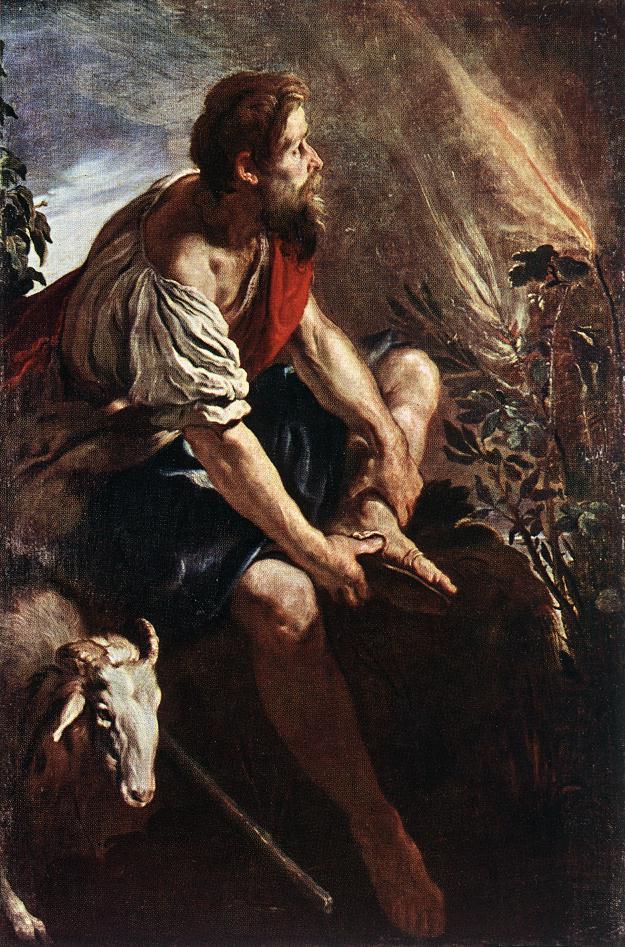
Picture by Domenico Fetti [Public domain], via Wikimedia Commons
Was Moses spiritual but not religious?
That seems to be a popular stance for many people who claim faith but do not have active involvement in any established expression of it.
![]() |
| Moses Before the Burning Bush by Domenico Fetti |
Moses was of the tribe of Levi which was where the Hebrew people later found their priests. So it is likely that Moses did hear the stories of Abraham and Isaac and Jacob. When Moses encounters God, he must have recognized God when he heard these names mentioned.
Living with the Midianites, Moses might have had the opportunity to worship other gods but not the God of his ancestors.
And so Moses might have been spiritual, believing in God but not religious in that he would have had no people in which to share the practices of faith. However, when God speaks to Moses, we see that his spirituality is calling him to be religious in the sense that religion is something shared by a community of people.
He is called to be religious in that he is called to responsibility for his people.
As we consider our own faith, it is much easier to love God than to love our neighbors. But maybe when we seek to only love God without any change of behavior toward other people, we are remaking God in our own image.
We'll see what God thinks of idols in subsequent chapters!
God invited Moses to repair the slavery of the Hebrew people. If you imagine God calling to you as God called to Moses all those years ago, is there some injustice that God is asking you to address?
Whatever it may be, we can imagine that God is also saying to us as God said to Moses, "I will be with you."
When we answer this call, we see that our spirituality also moves us to be religious.
Picture by Domenico Fetti [Public domain], via Wikimedia Commons
Thursday, February 11, 2016
Daily Devotion for Day 2 of Lent 2016
Scripture Reading: Exodus 2 (NRSV)
The first of today's stories is the more well-known. The parents of Moses were of the tribe of Levi which signified that they could be priests among the Hebrew people.
This is a Br'er Rabbit story in that it is about a subjugated people that tricked their way into success. Moses is actually raised as an Egyptian with all the privilege that brought. Yet he is also a Hebrew and still feels kinship with his people.
After killing the Egyptian, Moses flees to Midian where he lives in exile for years. This mirrors what his own people will endure centuries later in Babylon.
Moses seems to establish a life away from his people. He gets married and they have a son together. But he seems to never forget his roots. He even names his son as a play on words that is a reminder that he is not truly home.
These stories of Moses remind us that God is continually at work in our lives in a variety of ways. Sometimes it is behind the scenes. Sometimes we run away from our calling but it never really leaves us.
Is there a conflict from which you have run?
Is there something you need to resolve that will give you peace?
The first of today's stories is the more well-known. The parents of Moses were of the tribe of Levi which signified that they could be priests among the Hebrew people.
![]() |
| Br'er Rabbit stories showed that he survived by outwitting Br'er Fox and Br'er Bear who had more power. They were told by American slaves who needed their wits to overcome the cruelty of their masters. |
After killing the Egyptian, Moses flees to Midian where he lives in exile for years. This mirrors what his own people will endure centuries later in Babylon.
Moses seems to establish a life away from his people. He gets married and they have a son together. But he seems to never forget his roots. He even names his son as a play on words that is a reminder that he is not truly home.
These stories of Moses remind us that God is continually at work in our lives in a variety of ways. Sometimes it is behind the scenes. Sometimes we run away from our calling but it never really leaves us.
Is there a conflict from which you have run?
Is there something you need to resolve that will give you peace?
Wednesday, February 10, 2016
Daily Devotion for Lent 2016: Ash Wednesday
Scripture Reading: Exodus 1 (NRSV)
Much of the time in the Hebrew Bible which Christians refer to as the Old Testament, the prophets are sharing God's word with the people about their current behavior. They are often calling them to task over their lack of faithfulness. Their impending calamity such as invasion or destruction can be laid at their own feet.
The author of Exodus offers no such rationale for why God's people have ended up as slaves. We are not told that they were worshiping Egyptian gods or even forgetting the widows and orphans among them.
They end up as slaves not through any fault of their own but because they lost their connection to the royal family. Who you know was just as important in that time as it is today.
As I think about my own privilege, I realize that I have lots of connections that helped me to be successful. They have also helped keep me out of trouble.
With Lent, we often reflect on what Christ has done for us. If we believe that Christ is working through others on our behalf (preceding or prevenient grace), then it might be a good reflection for you today to consider and give thanks to God for three people that have responded to that call.
They may not even think about it as a call - they may just have helped you.
But as people of faith, we look at this and name it as Christ working in them or through them.
Why not drop an email, text, Facebook message or tweet to these people today simply expressing your gratitude for them being in your life?
Picture by Internet Archive Book Images [No restrictions], via Wikimedia Commons
Much of the time in the Hebrew Bible which Christians refer to as the Old Testament, the prophets are sharing God's word with the people about their current behavior. They are often calling them to task over their lack of faithfulness. Their impending calamity such as invasion or destruction can be laid at their own feet.
![]() |
| The sheer scope and size of the Egyptian buildings is impressive considering the limitations of their tools at that time. |
The author of Exodus offers no such rationale for why God's people have ended up as slaves. We are not told that they were worshiping Egyptian gods or even forgetting the widows and orphans among them.
They end up as slaves not through any fault of their own but because they lost their connection to the royal family. Who you know was just as important in that time as it is today.
As I think about my own privilege, I realize that I have lots of connections that helped me to be successful. They have also helped keep me out of trouble.
With Lent, we often reflect on what Christ has done for us. If we believe that Christ is working through others on our behalf (preceding or prevenient grace), then it might be a good reflection for you today to consider and give thanks to God for three people that have responded to that call.
They may not even think about it as a call - they may just have helped you.
But as people of faith, we look at this and name it as Christ working in them or through them.
Why not drop an email, text, Facebook message or tweet to these people today simply expressing your gratitude for them being in your life?
Picture by Internet Archive Book Images [No restrictions], via Wikimedia Commons
Tuesday, February 9, 2016
Disciplines are Much Easier When They are Theoretical
We have a regular "methodical" way of organizing our work as the people of God. It is through The United Methodist Book of Discipline which is revised every four years.
Within this work, we try to name our theology but also our practice. Making sure that we are putting what we believe into how we are living is key.
We don't always get it correct. In fact, there may be things in it with which we don't agree.
But there is a sense of covenant about it which allows us to trust each other.
If you had told me when I was a child that I would ever rely on something called a Book of Discipline, I would have shuddered for my future. I equated discipline with punishment.
In fact, anything that limited my personal desires was not something I would have claimed was a good thing.
As a child, I can recall my parents fasting (abstaining from eating) as directed by the church. They didn't make me participate since I was still growing but I remember thinking, "That sounds awful!"
When we begin to mature, we see that to deny ourselves can actually be beneficial.
The lessons we learn allow us to be better stewards of our relationships as well.
As we enter the Lenten season, it will begin with Ash Wednesday and end with Easter Sunday. The days in between are forty (plus Sundays) that remind us of the forty days that Jesus fasted in the desert. They also remind us of the forty years God's people wandered in the wilderness seeking the promised land.
With that in mind, my Lenten discipline this year will be reading and writing about the Book of Exodus. I will be posting a link to a daily reading along with my reflections so that you might join me as well.
For some of you, this will be a refresher in the stories of Moses. Others will be encountering these texts for the first time. Regardless, I hope that you find this daily discipline to be helpful to your spirit. Starting Wednesday, click on http://precedinggrace.blogspot.com/ each day and we'll journey together. Feel free to leave a comment on your own impressions of that day's reading or where you agree or disagree with mine.
This will make it more of a community reading which ties us back to covenant! My hope is that as we finish the last of the book on Easter Sunday, we will see how resurrection allows us to realize our promised land together.
In Christ,
Sam
Picture by Billy Hathorn at en.wikipedia [GFDL (http://www.gnu.org/copyleft/fdl.html), CC-BY-SA-3.0 (http://creativecommons.org/licenses/by-sa/3.0/) or CC BY-SA 2.5-2.0-1.0 (http://creativecommons.org/licenses/by-sa/2.5-2.0-1.0)], via Wikimedia Commons
Within this work, we try to name our theology but also our practice. Making sure that we are putting what we believe into how we are living is key.
We don't always get it correct. In fact, there may be things in it with which we don't agree.
But there is a sense of covenant about it which allows us to trust each other.
If you had told me when I was a child that I would ever rely on something called a Book of Discipline, I would have shuddered for my future. I equated discipline with punishment.
In fact, anything that limited my personal desires was not something I would have claimed was a good thing.
As a child, I can recall my parents fasting (abstaining from eating) as directed by the church. They didn't make me participate since I was still growing but I remember thinking, "That sounds awful!"
When we begin to mature, we see that to deny ourselves can actually be beneficial.
The lessons we learn allow us to be better stewards of our relationships as well.
| We'll get to the 10 Commandments on Saturday, March 5 of the daily schedule. The Book of Discipline is similar in many respects! |
As we enter the Lenten season, it will begin with Ash Wednesday and end with Easter Sunday. The days in between are forty (plus Sundays) that remind us of the forty days that Jesus fasted in the desert. They also remind us of the forty years God's people wandered in the wilderness seeking the promised land.
With that in mind, my Lenten discipline this year will be reading and writing about the Book of Exodus. I will be posting a link to a daily reading along with my reflections so that you might join me as well.
For some of you, this will be a refresher in the stories of Moses. Others will be encountering these texts for the first time. Regardless, I hope that you find this daily discipline to be helpful to your spirit. Starting Wednesday, click on http://precedinggrace.blogspot.com/ each day and we'll journey together. Feel free to leave a comment on your own impressions of that day's reading or where you agree or disagree with mine.
This will make it more of a community reading which ties us back to covenant! My hope is that as we finish the last of the book on Easter Sunday, we will see how resurrection allows us to realize our promised land together.
In Christ,
Sam
Picture by Billy Hathorn at en.wikipedia [GFDL (http://www.gnu.org/copyleft/fdl.html), CC-BY-SA-3.0 (http://creativecommons.org/licenses/by-sa/3.0/) or CC BY-SA 2.5-2.0-1.0 (http://creativecommons.org/licenses/by-sa/2.5-2.0-1.0)], via Wikimedia Commons
Monday, February 1, 2016
The Absolutes of Love
"(Love) bears all things, believes all things, hopes all things, endures all things."
Paul of Tarsus, ca. 53
These beliefs about love suggest a spiritual state rather than a simple, fleeting emotion. After all, who can't point to a love that did not endure or that let us down?
Paul is lifting up a vision of what it is that we encounter when we engage in the love of Christ. We seek to approach this love in the best of our relationships. But we are bound to sometimes fail those whom we love the most.
What happens then?
If love were one-sided, then we would simply let the relationship go and we would be solitary once more.
But love is not simply something I do but it is something in which we dwell.
When we are weak, love allows the other to be strong on our behalf.
If we engage love with integrity, we don't allow ourselves to be weak all the time. Rather, we share strength as often as we can.
But what if there are times when we are both weak?
In this instance, we have to trust in God to be strong enough for the both of us.
These are good reminders of how we are to be the church. Paul was writing to Corinth and they had their share of problems. Paul was reminding them of the very thing that binds them together when they falsely concluded that they were done with each other.
Sometimes in our weakest moments, God touches us and we remember who we are on our best days.
If this is not salvation, I don't know what is.
In Christ,
Sam
Picture by Jocelyn Augustino (This image is from the FEMA Photo Library.) [Public domain], via Wikimedia Commons
Paul of Tarsus, ca. 53
These beliefs about love suggest a spiritual state rather than a simple, fleeting emotion. After all, who can't point to a love that did not endure or that let us down?
Paul is lifting up a vision of what it is that we encounter when we engage in the love of Christ. We seek to approach this love in the best of our relationships. But we are bound to sometimes fail those whom we love the most.
What happens then?
If love were one-sided, then we would simply let the relationship go and we would be solitary once more.
But love is not simply something I do but it is something in which we dwell.
When we are weak, love allows the other to be strong on our behalf.
If we engage love with integrity, we don't allow ourselves to be weak all the time. Rather, we share strength as often as we can.
But what if there are times when we are both weak?
In this instance, we have to trust in God to be strong enough for the both of us.
These are good reminders of how we are to be the church. Paul was writing to Corinth and they had their share of problems. Paul was reminding them of the very thing that binds them together when they falsely concluded that they were done with each other.
Sometimes in our weakest moments, God touches us and we remember who we are on our best days.
If this is not salvation, I don't know what is.
In Christ,
Sam
![]() |
| Sometimes we carry our friends and sometimes our friends carry us. |
Picture by Jocelyn Augustino (This image is from the FEMA Photo Library.) [Public domain], via Wikimedia Commons
Subscribe to:
Posts (Atom)


.jpg)