Monday, April 28, 2014

Native American Ministries Sunday

Like many Oklahomans, I have some Native American ancestry.  It is fairly distant but on my mother's side, I have a great great great grandmother, Eliza Anne Raby, who was Cherokee and came west on the Trail of Tears.  Her mother died on the way and she was separated from the tribe.

Eliza was taken in by the Haney family and eventually married her adopted brother.

I can't imagine what it would be like to be forced from your home and then to lose not only your home but your family as well.  She must have been a tough woman.  She reared seven children and lived to be 68 which was above average for the 19th century.  

At that time, Native Americans were not granted the same social status as the European settlers.  In fact as they were brought into the Christian faith, many of their native cultures and traditions including their languages were considered inferior and were repressed.
I'm hopeful that the Cleveland Indians of Major League Baseball
may be phasing out the use of Chief Wahoo as a mascot.
Unfortunately, it is still an emblem on this season's uniforms.
To be honest, I'm shocked that it is still being used
in the 21st century.

Within many Christian traditions, these were even viewed as sinful. The spirituality of much of Native American culture was not seen as a valid vehicle for the grace of God.

Within United Methodism, we have begun to move past this and we do recognize the Holy Spirit working in and among Native American people within their own cultural traditions. As Wesleyans, we see that prevenient or preceding grace is present throughout the world and it is this understanding of God's love that allows us to see Christ at work within other faith traditions.

This Sunday is recognized as Native American Ministries Sunday in the United Methodist Church.  

This traditional Native American prayer has been included in our hymnals since 1989:

O Great Spirit,
    whose breath gives life to the world,
    and whose voice is heard in the soft breeze:
We need your strength and wisdom.
Cause us to walk in beauty.  Give us eyes
     ever to behold the red and purple sunset.
Make us wise so that we may understand
     what you have taught us.
Help us learn the lessons you have hidden
      in every leaf and rock.
Make us always ready to come to you
      with clean hands and steady eyes,
so when life fades, like the fading sunset,
      our spirits may come to you without shame.  Amen.


Sunday, April 20, 2014

Easter Sunday, April 20, 2014

"Last of all, as to one untimely born, he appeared also to me."

       Paul of Tarsus, 1 Corinthians 15:8

As the gospels were written 40 to 60 years after the resurrection, we see that the earliest written record we have of the Easter resurrection come from the letters of Paul which were written to the early church.  It was likely written in the 50's which would put it at twenty years after - during the early growth of the Jesus movement among first Jewish and then later Gentile populations.

Of course, Paul was not one of the original disciples.  His experience with Jesus entirely lies within the appearance of the risen Lord to him on the road to Damascus.

This must have been frustrating to those who followed Jesus in the flesh.

Who does Paul think he is?

Of course, his experience is more in line with our experience.  None of us ever walked with Jesus on the dusty roads of Judea.  We didn't sit at his feet as he told and explained the parables.

Our experience lies within the mystical just as Paul's did.

Our experience also lies within the body of Christ - the church.  How we share together in worship shapes us and forms us.  It allows the risen Christ to live within us as we seek to change the world for the better.

On Easter, we try to approximate God's kingdom coming on earth as is is in heaven.  Just as Jesus taught us to pray.

We celebrate at worship.

We gather with family to eat together.

We indulge in whatever things we gave up for Lent!

As we think of those early disciples who walked and talked with Jesus, we see that his teaching rubbed off on them.  How else would they have allowed this upstart who was so self-assured to preach to the world?  And if they hadn't allowed this, we likely wouldn't be gathering for worship today or reading this blog.

So on this Easter, I'm thankful to the disciples for following and listening.
Just as Paul was blinded by the light, the light
is continuing to shine to people today.
Can you see it?


Because I'm untimely born as well.  And yet we see the time is right.

Christ is alive today just as he was for the disciples and just as he was for Paul.  Our witness is just as important as Paul's.

Maybe future Christians will be thankful for you!


Photo by EzykronHD (Own work) [CC-BY-SA-3.0 (http://creativecommons.org/licenses/by-sa/3.0)], via Wikimedia Commons

Saturday, April 19, 2014

Day 40 of Lent, Holy Saturday, April 19, 2014

They took the body of Jesus and wrapped it with the spices in linen cloths, according to the burial custom of the Jews.
                           John 19:40 (NRSV)

On the Saturday between Good Friday and Easter morning, it must have been somber. The body had been wrapped and anointed.  

What would Jerusalem have been like?  It would have been the Sabbath and so there would not have been a lot of activity.  It would have been quiet and still.

Sometimes after the loss of a family member, there may be a lull before the service if all the tasks have been accomplished.  Usually there are extended family who have gathered for the service.  We usually bemoan the fact that we only get together like this for funerals.  

The funeral service is meant to be a celebration of life in the church.  It is seen as a movement from this life to the life eternal.

Most of the time when I am meeting with families, I hear them say to me, "We don't want this to be too depressing.  He (or she) would have wanted us to celebrate rather than mourn."  
Garden tomb in Jerusalem

While there is a sense and tone of celebration, it is a little silly to think that we won't mourn a loss. It is part of our human nature. We are sad that our earthly future will no longer include our loved one in our plans.

This must have been how the disciples felt on that Saturday. They may have been asking God, "Why?" They would have been remembering all the people Jesus healed and even the ones he raised from the dead.  As his disciples, I wonder if any thought about trying to raise Jesus from the dead as he had done others.

Would they have wondered if Jesus performed those miracles so that they might do it for him? He did talk about being raised up in three days - what if this was part of the plan and they simply didn't understand?

Some would also have been wringing their hands over their desertion.  What if they had done a better job of helping Jesus escape? 

And the thoughts would have gone on and on.

They may have thought about being reunited someday at the resurrection.

They imagined this to be at the end of time.  

But sometimes God's time and our time don't coincide.  The end would come early the next morning.

It was actually a beginning...


Photo by Nemo (Own work) [CC-BY-SA-3.0 (http://creativecommons.org/licenses/by-sa/3.0)], via Wikimedia Commons

Friday, April 18, 2014

Day 39 of Lent, Good Friday, April 18, 2014

“My God, my God, why have you forsaken me?”

                     Jesus of Nazareth, Matthew 27:46 (NRSV)

On Good Friday, when we remember the crucifixion, there may be opportunities for you to hear the story of the Passion recounted as liturgy for the church.  It is important for the Body of Christ to gather and to remember what happened to the body of Jesus on this day almost 2,000 years ago.  

To die upon the cross was a cruel and terrible thing.  It was unfortunately more common for those living in the Roman empire to witness as it was used as a way of controlling the masses.

The story of Jesus moves to tragedy today.  As we remember all of the good things he did - how he was present for those who felt lost or abandoned - we may feel that this is sadly ironic that Jesus now feels abandoned.  His disciples have left him and it seems as if God has as well.  

It is important for us to understand that Jesus is quoting from Psalm 22.  In fact, it is almost equally important for us to read this Psalm on this day. Within the Psalm, we see that there is more of the Passion narrative acted out and written down hundreds of years before Jesus experiences it.  The fact that it has happened before does not take away from the Passion of Jesus.  The fact that it continues to happen in the world today does not remove the power of the cross.  

In fact, it makes it all the more significant. 

In verses 7-8, the antagonists call into question the relationship with God.  If God loves you, why are you suffering?  Why doesn't God save you?  

This profound question that all who suffer ask is repeated in the Passion as recounted by Matthew in 27:43 when the religious leadership declares, "He trusts in God; let God deliver him now, if he wants to, for he said, 'I am God's Son.'" (NRSV)

But as we read on within the Psalm, we see that faith is restored.  God appears unseen but is present even amid the suffering.  

On Good Friday, Jesus experiences the deepest suffering.  And yet, Jesus also transcends even this suffering for us.  For we realize that even in our suffering - in the midst of our deepest loneliness - that Christ is with us in this.  That God somehow has walked this road before.

It is enough.


Christ of St John of the Cross by Salvador Dali, 1951.
The original hangs in Kelvingrove Art Gallery and Museum in Glasgow.


Thursday, April 17, 2014

Day 38 of Lent, Maundy Thursday, April 17, 2014

Peter said to him, “You will never wash my feet.”

                               John 13:8

The story of Jesus washing the feet of the disciples is only contained within the Gospel of John.  It is an extremely intimate story of a rabbi who taught his students what it really means to lead.

In that day and age, having your feet washed was an important service. Anyone who has ever worn sandals on a dirt road knows what it is to have dirty feet.  If animals regularly use the road, you would begin to get an approximation of what first century feet would look like in Judea.

Those with means would have a servant wash the feet of any guests entering the home.  The servant on the lowest rung of the ladder would be the one stuck with this job.  I'm sure servants were always happy to see someone new hired to take on this task!

So the reversal that Jesus attempts is understandably met with resistance. To wash the feet of those beneath him in status would take away from his social status.  Peter protests.

Jesus does exactly what he sought out to do.

Is he diminished?

I don't think so.  

Bishop Hayes encourages Jacki Banks in the foot washing ritual May 29, 2012,
during the Service of Ordination at Annual Conference,
held at Boston Avenue UMC in Tulsa. Photo by Holly McCray
Bishop Hayes of the Oklahoma Conference washed the feet of those he would ordain to Elder and Deacon at their ordination service.  If he felt any anxiety about being an African American man washing the feet of white people, he gave no indication of it.  

I believe that in this moment, he set any racial tension of service aside and took on the role of Christ as servant leader.

Was he diminished in doing so?

Not in the slightest.  In fact, his stature only increased among those whom he leads in our conference.

To be on the receiving end of having your feet washed is also humbling.  In the moment, you don't imagine yourself above them but somehow thankful for what they are doing for you.

As we approach Good Friday, may we pray about how we might adopt this attitude of service for others in all the ways we think and speak and act.  May we remember those in service to us in multiple ways and see ourselves not as above but rather as grateful for what they are providing.


Wednesday, April 16, 2014

Day 37 of Lent, Wednesday, April 16, 2014

But I am poor and needy;
    hasten to me, O God!
You are my help and my deliverer;
    Lord, do not delay!

           Psalm 70:5 (NRSV)

Psalm 70 is part of the daily lectionary reading for the Wednesday of Holy Week.  We can see how it fits into the overall theme of the week.  Can you imagine Jesus praying over this Psalm in the Garden of Gethsemane shortly before his arrest?

When we are facing stresses that others may not understand, we often feel lonely.  It can even be in the midst of friends and family. As Jesus prayed in the garden, he found his disciples sleeping. "Simon, are you asleep?  Could you not keep awake one hour?" (Mark 14:37, NRSV).  I think that Jesus may have felt lonely in his time of trial even though his disciples were with him initially. They soon deserted him and he was left truly alone.

As we encounter loneliness, studies have shown that it is actually contagious.  This seems counter-intuitive.  If you are around others, why are you lonely?  This shows us that it is more about mindset than the proximity of others.

Since this is a human condition that all people experience at some point in life, our goal would then be to reduce the amount of loneliness that we experience ourselves so that we don't pass it on to others.

Pulling others out of the pit is part of the call of Christian faith.  Yet at the same time we must be sensitive to what is going on in their lives.  Grieving and loss elicit real feelings that shouldn't be glossed over.  But pessimism about some of the daily things of life can be turned around.

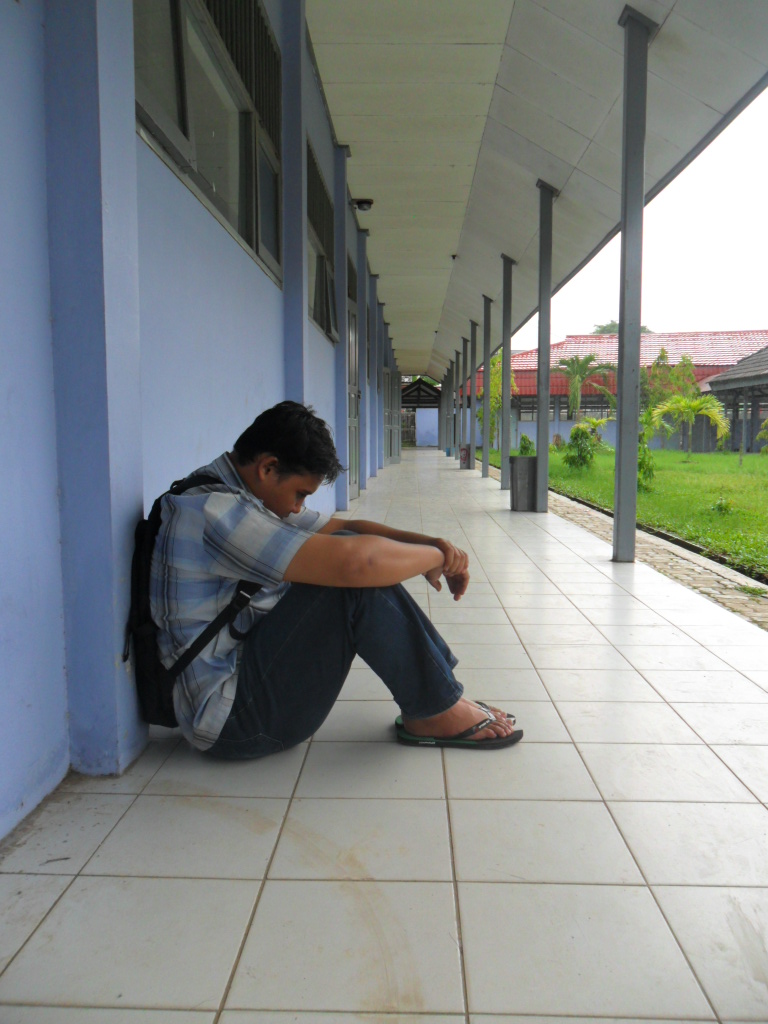
Hold up the mirror to yourself: do you tend toward pessimism or optimism?

As we journey with Jesus to the cross, we are reminded that there are tasks we each face that are hard if not downright deplorable.  How we choose to face these is up to each of us.

But we are also reminded that we don't face them alone.


Photo by Arief Rahman Saan (Ezagren) [Attribution], via Wikimedia Commons


Tuesday, April 15, 2014

Day 36 of Lent, Tuesday, April 15, 2014

Do not remember the former things,
    or consider the things of old.
19 I am about to do a new thing;
    now it springs forth, do you not perceive it?

               Isaiah 43:18-19

There's a viral video going around featuring some college students playing Wheel of Fortune.

One of the students, Julian, has all the letters of the puzzle guessed but blows the pronunciation.


He pronounces the name, "Ah-chill-ess" rather than "Ack-ill-ease". According to the rules, this is considered a wrong answer.

Evidently, he had a pretty large sum of money on the line as well.

It's one thing to embarrass yourself but on television?  Now with the internet, it's even worse.  The worst of the worst lives on in infamy.  

Fortunately, we don't have to define ourselves by our poor actions.  God allows us to come back from bone-headedness and even to thrive.

As we continue in Holy Week, we can see that the disciples had some missteps that were a lot worse than blunders.  They fall asleep when they should be praying.  They run away in fear when Jesus is arrested.  They deny him to strangers.  They even betray him for money.  Not a great week for them to remember at all.

Outside of Judas, all of them went on to bigger and better things for which they are remembered.  

They weren't defined by their weakness but through identifying with Christ.

We've all got things we would like to forget.  How is it that you want to be remembered?