Sunday, May 28, 2017

United Methodist Annual Meeting-Time

Part of being United Methodist is understanding how we relate to the various other United Methodist churches around what we refer to as “the connection.”  This week, many Oklahoma United Methodists will gather for our annual meeting which we often refer to as “annual conference.”  This meeting will include business such as electing officers and approving next year's budget.  We will honor our clergy who are transitioning as we celebrate retirements for those finishing their full-time work as well as commissioning and ordaining those emerging in leadership at the beginning of their careers.  We also will remember those clergy who have died since the last annual conference.

For clergy, our church membership is within the annual conference rather than the local church.  My wife and children all have their membership at Edmond First but mine is within the Oklahoma Conference.  When I retire (some day long from now), my membership will continue to remain in the Oklahoma Conference but I will be required to have a charge membership at a local church somewhere.  This is to ensure that I am remaining active within United Methodism.  We have quite a few clergy with their charge memberships within our congregation and it becomes a gift to the local church as they share their wisdom with us.

Our church has received the New People New Places grant in order to bring on an additional clergy person on our staff.  This grant was established a few years ago by Oklahoma United Methodism's Annual Conference Council to encourage various ministries within our conference to try to reach people within the community that we are currently missing.  A local church is eligible to receive this grant for up to three years.  Because the cost of clergy has risen in the past decade, we are utilizing the grant to bring on a new staff member with the hopes of receiving a declining award for the next two years so that we might take on the new salary more gently as we grow the church.

This means that the pressure on the new clergyperson is to grow the church enough to afford the additional salary.  We also have pressure to receive the grant funding while we move in this new direction.  Fortunately, our church is already healthy and growing so that we anticipate a smooth transition.

We were told that Trey Witzel would be appointed here June 1.  I was excited that our church would be receiving Trey as I served as his mentor through the candidacy process.  I’ve known Trey since he was in Junior High as he grew up within our district at Village United Methodist Church in Oklahoma City.  We saw each other at various district events including summer camp each year.  Trey recently graduated with his master of divinity degree from Boston University’s School of Theology (a United Methodist institution).  His wife Addison grew up in Edmond and will be working at Oklahoma City University (another United Methodist institution).  Trey served Tewksbury UMC as a student local pastor while in Boston and grew the church from 25 to 55 in worship attendance. 

Addison and Trey were married before they
left for Boston three years ago right
after they finished undergraduate studies
at Oklahoma City University together.
Trey will be commissioned as a provisional elder on Wednesday night at 7:00 pm in the sanctuary of Saint Luke’s United Methodist Church in Oklahoma City.  All are welcome to attend and there will be a reception following if you would like to stop by and introduce yourself.  Trey will have a minimum of two years in which he will serve as a provisional member before he is eligible for ordination and full conference membership.  While he is serving in this capacity, he is still allowed to oversee the sacraments of Baptism and Holy Communion within the bounds of his appointment.  Once he is ordained, he will be able to preside over the sacraments in other locales as well.   

This Sunday will be Trey’s first at his new appointment at Edmond First UMC.  We will also have a reception for Trey and Addison in the Christian Activity Center following worship.  There will be food trucks in the alley which will begin serving at 11 am if you go to the early service. 

We are pleased at how God is leading us into the future.  Many churches are cutting staff positions rather than adding them at this point and so we feel very fortunate.  I hope that if you are in the area (and don’t already attend another church), you will join us as we worship together!

In Christ,

Sam


Monday, May 22, 2017

Adversarial Relationships

Lectionary Reading for Sunday: 1 Peter 4:12-14; 5:6-11 (NRSV)

At this point in the letter, there is the assumption that suffering and persecution are a part of the Christian life.  It could be that the author is speaking of persecutions directly experienced or of those related by colleagues.  In any event, there seems to be a sense of solidarity in suffering as if it is helpful to realize that you are not the only one in turmoil.

The old adage "misery loves company" helps us to remember that we don't do as well in isolation.

The Christian community works well when it lifts up its various members when they are down.  It does even better when it applies this same helping hand to anyone in its vicinity.  Churches are some of the best organizations at responding to disaster relief. We step up when we see the need staring us in the face.

To be isolated in the midst of crisis is to often face despair.  People working through grief know that it is easier when shared with others.  We instinctively understand that we need to lean on one another from time to time.

The second part of verse 5:8 struck me as it declares, "Like a roaring lion your adversary the devil prowls around, looking for someone to devour."  This metaphor is apt.  Human beings have known for millennia that it is easier to get picked off by lions when you stray from the group.  There is strength in numbers - spiritually as well as physically.

All primates are social animals with
the need for interaction and sharing with one another. 
This verse reminds me of the story of Cain and Abel in Genesis 4.  After God favors Abel's offering, Cain is upset and God states in verse 7, "But if you do not do what is right, sin is crouching at your door; it desires to have you, but you must rule over it." This particular verse is from the New International Version which makes the metaphor of sin similar to the roaring lion in 1 Peter 5:8.

These metaphors characterize evil as a force that is pursuing us.  In order to overcome it, our best defense is to share in the strength of the Holy Spirit which is most often expressed within the Christian community.

What does it mean for us to share in the suffering of one another?  How do we do this without getting dragged down with those in pain?  In other words, how do we lift them up rather than empathizing so much that we are now the ones needing help?

Prayer for the day:

O God, we have known and believed the love that You have for us.  May we, by dwelling in love, dwell in You, and You in us.  May we learn to love You Whom we have not seen, by loving our brothers and sisters whom we have seen.  Teach us, O heavenly Father, the love wherewith You have loved us; fashion us, O blessed Lord, after Your own example of love; shed abroad, O Your Holy Spirit of Love, the love of God and humanity in our hearts.  Amen.

                                  Henry Alford, Church of England, 19th Century


Photo by Aftab Uzzaman via Flickr.com.  Used under the Creative Commons license.

Tuesday, May 16, 2017

The Descent into Hell

Lectionary reading for Sunday: 1 Peter 3:13-22 (NRSV)

This reading starts out a little dubiously when it asks, "Now who will harm you if you are eager to do what is good?"

Could this have been asked a little tongue-in-cheek as we obviously knew what had happened to Jesus?  If this letter was written by a disciple of Peter's, the martyrdom of Peter would already have been known as well.

Every person faces choices from time-to-time.  Sometimes if we choose not to decide, the choice goes away.  Sometimes the choice to do what is right is tiring and takes effort.  We know there will be push-back.

A person who lives with a functioning alcoholic may choose not to make the drinking an issue in order to (seemingly) preserve the relationship.  It is almost always easier in the short-term to go with the status quo.

Sometimes imprisonment is perplexing as we
wonder aloud, "How did I get here?"
The reading speaks of Jesus making "a proclamation to the spirits in prison" in verse 19 immediately following his death on the cross.  This is the doctrine of Jesus descending to the dead or to Hell as proclaimed in the Apostles' Creed. Theologically, this offers salvation to all the souls who died before Christ redeemed humanity.  It seems that God is not content with the redemption of those born after Jesus, but actively seeks all people.

This is a part of the meaning of the resurrection.

As followers of Jesus, we are called to live out this resurrection faith.  And that means that we are to do the right thing.  Not just sometimes, but all the time.  This is not meant to make us weary or to find it an impossible task.  As we remain in Christ, our own natures begin to shift toward the desire for compassion for all as we take on Christ's nature.

The difficulty of this is when we run into resistance for our good efforts.  Not everyone wants our compassion and some people prefer to remain in prisons of their own making. When these are strangers, it is a little easier to let go.  When they are people we love, their problems can become fused into our lives.

Ultimately, these are times when we must cling to our resurrection faith.  We remain hopeful in the salvation in Christ that transforms lives not only in the next life but in this life.

Some days that is all we have.  


Photo by Tiago Pinheiro via Flickr.com.  Used under the Creative Commons license.

Sunday, May 7, 2017

Growing into Salvation

Lectionary Reading: 1 Peter 2:2-10 (NRSV)

I like how the author speaks of growing into salvation in verse two.  So many times we speak of salvation as an event done by Jesus on our behalf or we speak of it as a moment in which we cross over from damned to blessed.

While these popular usages attempt to define our theology, they may also be limiting for how God works in people's lives.  Growing into salvation implies a process.  This fits with the Wesleyan idea of sanctifying grace in which we grow into the likeness of Jesus Christ.

As I consider my own growth as a Christian, much of it stemmed from the narrative my mother would share.  These were stories of my very young childhood that would get repeated as part of the family lore.  I heard them countless times growing up so that they began to shape me through their telling.

For example, once my siblings and I all received full-sized candy bars for a treat (this was unusual and the reasons are now lost).  I gobbled mine down and my older sister Becky saved hers for later.  When she finally got around to eating it (I think it was a Three Musketeers), I asked her for a bite.  She replied, "No, Sam, you already ate yours!"  I paused for a bit and asked her, "Becky, remember sharing?"  Of course, I couldn't pronounce the letter "r" and so it came out, "Becky, wemember shaiwwing?" This was a lesson the older family members were trying to ingrain in me.  She groaned and gave me a bite.

This story helped me to understand that cunning and creativity are better pursuits for getting what you want than whining or throwing a fit.  One could argue that this was more about manipulation than it was about learning to share.  However, it also taught an important lesson from my sister.  The value of sharing is more important than the irritation you obviously feel from a little brother.

Sometimes, we are reluctant to share if
the recipient seems like a pest!
It taught me that sharing is what we should pursue even if a person is taking advantage.  If my fundamental nature is to share, then a person cannot take advantage of me.

This is the very nature of grace that we receive in Christ Jesus.  It is something I learned a little bit at a time through these important women in my life.  I hope that you will take the time to reflect upon the life-giving things your own mother did for you this week as we approach Mother's Day.  I recognize that some have an easier time of this than others but any difficulty with this meditation may end with fruit and blessing for you.

I give thanks to God for my own "growth in salvation" and for my mom's hand in it.  


Photo by Timothy Vogel via Flickr.com.  Used under the Creative Commons license.

Monday, May 1, 2017

Walking through Darkness

Lectionary Reading for Sunday: Psalm 23 (NRSV)

The twenty-third Psalm is probably the most well-known of all the psalms.  It is often a go-to comfort passage for funerals.  When people do not express a preference, I often use it in a graveside service if we are coming from worship at the church or chapel.

The familiarity for many people (especially in the King James Version) is helpful as we consider our grief or loss.  While the NRSV is more accurate in translating the ending as dwelling in "the house of the Lord my whole life long", the KJV speaks more to eternity for a memorial as it reads, "I will dwell in the house of the Lord forever."

My cup overflows.
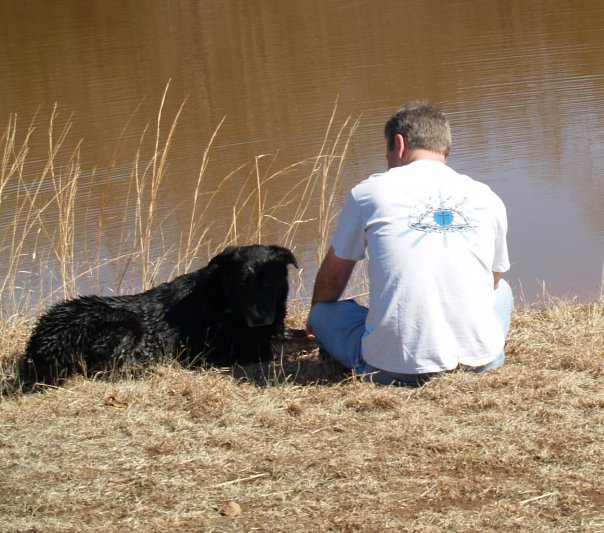
Green pastures and still waters offer a peaceful setting that is helpful when thinking of eternal rest. These can apply to more than people.  One of our faithful dogs, Darwin, was a mixed breed of German Shepherd and Black Labrador.  He used to love swimming in our family pond near Stillwater.  It was enjoyable just to watch him go for a dip.  He would do lazy circles in the water and when he would get close to the shore, he would turn and head back out taking long slow strokes with his big paws.  You could tell that he just loved the water.

One of his favorite games was fetching a plastic fish on the end of Kyla's Barbie fishing pole.  You could cast it into the pond and Dar would go after it every time as you reeled it in.  If he caught it, he would bring it back to shore and would deposit it unharmed for another go.

I loved that dog!

Sometimes I wonder if I will see him again after this mortal life is over.  Will there be a large pack of dogs waiting for me?  It is comforting to think so.  I've heard some say that it wouldn't really be heaven without their beloved pets.  Since there is no way of knowing, I'm not going to argue against it.

Pets, just like people, can be emissaries of God's grace in our lives.  They may even help us through the dark valleys that everyone must walk from time to time.  We each experience God's presence in different ways.  I think the unconditional love of a dog has often expressed the Divine presence to me more times than I could count.

Tuesday, April 25, 2017

The Sound of (sheer) Silence

Scripture Reading: 1 Kings 19:1-18 (NRSV)

Elijah is one of my favorite figures in the Bible.  In the previous chapter, he has a lot of courage to face down the prophets of Baal when he was so greatly outnumbered.  He trusts in God to see him through and God does not let him down.

That's why this story is so important.  After the dust settles, Queen Jezebel threatens his life because she was a supporter of Baal.

And even though he just had a victorious showdown with miraculous intervention, he fears for his life and heads for the hills.  As an outside observer, we want to shake some sense into Elijah and say, "After all you just witnessed, why would you run?"

But what makes this such a great story is that it shows Elijah as all-too human.  We all have moments of courage and cowardice.  We want to highlight our bravery and sweep the not-so-spectacular moments under the rug.  I would be happier if no one else knew anything about them.
There is something transcendent about
the high places on our planet.

Yet, the Biblical authors share these details precisely so we can connect with them.  To be afraid is to think with blinders on.  When we are afraid, our ability to make good decisions actually decreases substantially.  So Elijah runs away when maybe the best thing for him would be to stand firm in the Lord.

Elijah travels to the same mountain where Moses encountered God and received the 10 Commandments.  He sees a lot of flash in wind, earthquakes and fire but he doesn't perceive God in any of the chaos.  This reminds Oklahomans in particular that God is not sending tornadoes as retribution!

Rather, Elijah encounters God in the stillness following the turmoil.  The New Revised Standard Version relates a "sound of sheer silence."  The King James Version translates it as a "still small voice."  I think I prefer the new Common English Bible which states, "there was a sound. Thin. Quiet."

This reminds us that we can fill up the space in life with a lot of noise.  We can say a lot of words and phrases when we pray.  But maybe the most meaningful communication with God is when we can stop and listen.  When we hear nothing, our faith can allow a connection that is greater than the absence of sound.  It is mystical and it allows us to simply be.

Elijah interprets that God is not done with him yet.  In fact, he is not the only faithful person alive.  God begins to connect Elijah with others so that God's work can take on greater meaning.  But he might not have been able to hear this if he hadn't stopped running and stopped talking.  Good lessons to be learned almost three thousand years later!

 
Photo by Trekking Rinjani via Flickr.com.  Used under the Creative Commons license.

Tuesday, April 18, 2017

A Witness to Resurrection

Lectionary Reading: Acts 2:14a, 22-32

The context of the world during the early days following the resurrection was very different religiously than it is today.  It is strange to think that the majority of people on the planet had never heard of Jesus.  Christians today often take it for granted that everyone within our culture knows at least some of the basics of our faith.

After all, even non-religious people celebrate Christmas.

How did we go from obscurity to dominant?

Peter mentions in the above reading that the disciples were all witnesses to the resurrection.  Of course, by the time the Acts of the Apostles was written, most of the witnesses to the resurrection were in the third and fourth generations.

Being a witness to the resurrection originally meant "eye-witness" as in "we saw Jesus risen from the dead."  As people heard Acts read to them, "all of us are witnesses," began to take on a different understanding.  They would have seen themselves as a part of the movement.  They are also witnesses to the resurrection because Christianity is a living faith.

The fact that they made this leap of understanding is evident because we are recipients of this faith today - a faith that crossed two millennia and an ocean.  The difficulty for Americans is that we grew up in a culture where the majority were already witnesses to the resurrection.  And so we began to assume that everyone was already part of the story.

This old Sunday school postcard  assumes
that the truant friend is "lost" while the
regulars are "found."  This may not be the kind of
witness we want to project today.
This dampens the urgency of sharing as a witness.  And so this led to the plateau of American Christianity which now finds itself in decline.

What does it mean for us to reclaim our identity as witnesses to the resurrection?  At some point, we must quit assuming that others claim the Christian faith.  The difficulty of sharing the faith is that when we were dominant, Christians sometimes adopted an arrogant stance.

How do we prioritize the sharing of faith while at the same time keeping an air of humility?  I believe it begins with the resurrection becoming a key part of our lives.  This means that the witness is something we don't aspire to do as much as how we go about living our lives.


Photo by wackystuff via Flickr.com.  Used under the Creative Commons license.