Tuesday, March 1, 2022

Reading through Luke

As I prepare going through Luke for the season of Lent (see yesterday's post), I thought it might be helpful for me to post my schedule in advance.  I recognize that some people may have days when they would rather read the Bible portion ahead of time due to their schedules.

So, here's what the readings will look like if you choose to join us:

March 2 Ash Wednesday Luke 1:1-25 John the Baptist

March 3 Luke 1:26-80 Birth announcements

March 4 Luke 2:1-24 The Nativity

March 5 Luke 2:25-52 Jesus at the Temple

March 6 First Sunday in Lent - no devotions this day since I'm sure you'll be in worship!

March 7 Luke 3:1-38 Jesus' baptism

March 8 Luke 4:1-30 Jesus' temptation and public emergence 

March 9 Luke 4:31-44 Jesus in Capernaum

March 10     Luke 5:1-26 Jesus calls the disciples and heals

March 11     Luke 5:27-39 Jesus calls tax collectors

March 12    Luke 6:1-49     Activities on the Sabbath

March 13     Second Sunday in Lent - no daily devotion today!

March 14    Luke 7:1-35     Raising from the dead and witness to the dead

March 15    Luke 7:36-50 Forgiveness and Gratitude

March 16    Luke 8:1-25     Parable of the soils

March 17    Luke 8:26-56 Jesus heals a woman and a dead girl

March 18    Luke 9:1-36     Jesus feeds 5000, transfigured

March 19    Luke 9:37-62 Following Jesus to Jerusalem

March 20     Third Sunday in Lent - no daily devotion today

March 21    Luke 10:1-42 Good Samaritan & Martha & Mary

March 22    Luke 11:1-26 Lord's Prayer

March 23    Luke 11:27-54 Jesus condemns Pharisees & legal experts

March 24    Luke 12:1-34 Warnings of Jesus

March 25    Luke 12:35-59 Conflicts and judgment

March 26    Luke 13:1-35 Healing on the Sabbath

March 27    Fourth Sunday in Lent

March 28    Luke 14:1-24 Parable of the Banquet

March 29    Luke 14:25-35 Cost of Discipleship

March 30    Luke 15:1-10 Lost Sheep & Coin

March 31    Luke 15:11-32 Lost Son

April 1        Luke 16:1-13 Parable of Dishonest Manager

April 2        Luke 16:14-31 Divorce & Lazarus

April 3        Fifth Sunday in Lent

April 4        Luke 17:1-37 Signs of the Apocalypse

April 5 Luke 18:1-17 Unjust Judge, Pharisee & Sinner, Blessing of Children

April 6 Luke 18:18-43 Difficulties of riches, prediction, blind man healed

April 7 Luke 19:1-28 Zacchaeus & Parable of servant who buried the coin

April 8 Luke 19:29-48 Procession into Jerusalem, Temple thieves

April 9 Luke 20:1-47 Authority & tenant farmers

April 10    Palm/Passion Sunday no daily devotion today

April 11 Luke 21:1-19 Depending on God

April 12 Luke 21:20-38 Dulling of the spiritual mind

April 13 Luke 22:1-30 Holy Communion - debate over greatness

April 14 Holy Thursday Luke 22:31-71 Peter's denial

April 15 Good Friday Luke 23:1-25 Pilate, Herod & Barabbas

April 16 Holy Saturday     Luke 23:26-56 The Cross

April 17 Easter Sunday     Luke 24:1-53 Resurrection

While officially, Lent ends with Holy Saturday, I have usually posted the final chapter on Easter since it features the resurrection in the gospels.

Blessings on your Lenten season this year!

In Christ,

Sam


Sunday, February 27, 2022

Lenten Disciplines

As I prepare for Lent this year, even though I am not regularly pastoring any particular church, I am planning on keeping with my annual Lenten discipline of reading though a book of the Bible and sharing some of my thoughts on it.

This year, my plan is to revisit the Gospel of Luke which I last covered in 2013.  Since we live in a different day and age, I'm sure that my reflections will be nuanced with how Luke speaks to us today.

The church is certainly in a different place today.  We are in the middle of a cultural shift in the United States where regular worship attendance is waning.  While we were already experiencing that in 2013, the interruptions in worship due to Covid have accelerated the gaps we were already seeing in younger generations.

The isolation has also helped speed up the polarization we are seeing in the United States as well as around the world.  

This has made being a pastor more difficult as we've seen people migrate to other places of worship as well as stop altogether.  And just as we've seen church goers rethink their faith, we are also seeing more pastors consider other professions.

Within The United Methodist Church, we have seen turmoil over the inclusion of LGBTQ+ persons somewhat on hold as we await the postponed 2020 General Conference where legislation is adopted.  We are seeing the likelihood of the Global Methodist Church emerging as a more conservative alternative to the UMC.  

Some churches will leave to this denomination, but I believe most will remain within the UMC.  The difficulty is that most of our churches have people on both sides of this issue.  In rural areas, there are not options but rather single United Methodist churches that try to remain home to a variety of faithful believers.

With all of this going on, the season of Lent where we adopt spiritual disciplines may be a welcome relief to the stress of our "regular" lives.

If you want to spend some time with me in reading through Luke, I invite you to do so.  You are welcome to comment your own thoughts and reactions which makes it more of an online study.  Of course, you are also welcome to share these via social media or direct emailing the link.  The new devotions will show up daily in the wee hours of the morning for those who are early risers at this site (follow this blog by clicking the tab at the right).  I'll post them to Facebook and Twitter each day a little later in the morning.

Regardless of whether you join in with reading Luke, I would invite you to adopt some kind of spiritual discipline for the forty days leading up to Easter.  With all of the changes going on in the world today, the renewal of spiritual strengths allows us to meet these changes with a greater sense of God's peace in our lives.  And I think the world could use more peace right now!

In Christ,

Sam


Photo by Roy via Flickr.com.  Used under the Creative Commons license.


Thursday, December 23, 2021

Why Do We Celebrate Holy Communion on Christmas Eve?

For those raised in the church and especially for those of Roman Catholic or Episcopalian backgrounds, this is an expectation rather than a question.

But in American society, we have seen a rise in Christmas Eve candlelight services even in denominations that are not considered traditionally liturgical.  For those within the United Methodist tradition, the Christmas Eve service includes Holy Communion.  Fortunately, we feature an open table meaning that all are welcome to come and join us in receiving the bread and the juice.  At Christmas, we often have extended family members or friends join us which means they are welcome to fully participate in the service.

I always appreciated that we recognize God's invitation through this sacrament.

I think every generation wants community.
And every community has the potential of 
both healing and harm. Which will we choose?


But as our society becomes increasingly distant from organized religion, there may be some that attend that balk at participating in Holy Communion.  It may be too ritualistic for them.  It may be too spiritual.  In our particular time of spreading germs, it may be too communal!

While we'll have to leave it to the individual churches to address the safety concerns, I would like to share why we offer Holy Communion during this particular service.

Holy Communion has always included elements of eschatology which refer to the end times.  As we think about the end of time, we may think about all of our debts finally being paid.  We have finished the race.  We have completed all the work assigned to us.  We are able to put down our grudges and let go of our bitterness.  At the end of time, we imagine enemies laying down their weapons, whether these be physical or verbal.  At the end of time, we believe that peace will reign.

Dr. Martin Luther King, Jr. famously stated "We shall overcome because the arc of the moral universe is long, but it bends toward justice."  This is an eschatological statement.  It is saying that eventually things will be better because God is at work.

As Christians consider the incarnation of God in Jesus Christ at Christmas, this is a punctuation in history for us.  It is a way that we make a statement that these end times characteristics are upon us now!

Within Holy Communion, we recognize that in history, Jesus met his own end violently.  Not only did he die horrifically, but his own disciples deserted, denied and betrayed him.  As a particularly perceptive person, Jesus seemed to know where his own actions were leading.  In other words, he was not surprised by the outcome of the cross.  Within our ritual, we recognize that Jesus precedes this violent end with a meal with said disciples.  Isn't this a statement of eschatology?

And so, as we gather on Christmas Eve, we participate by making our own statement that when we commune with Christ, we are punctuating history today.  We are acting out our own statement of laying down our judgments against each other.  We are setting aside our anger, our fear and our animosity.  We are choosing to break bread with one another in peace, saying at least for this moment, "This is who we are in Christ."

So, if you are nominally religious, agnostic or even atheist, you are still welcome to join us at the table.  All people need to eat, no matter what they believe.  On Christmas Eve, within the United Methodist Church, we are simply saying, "Why not choose the way of peace and eat together?"

I can't think of a better way to celebrate Christmas!


Photo by Ivan via Flickr.com.  Used under the Creative Commons License.


Wednesday, October 27, 2021

Wesleyan Rule Makers and Rule Breakers

I recently read Michele Gelfand’s book, Rule Makers, Rule Breakers: How Tight and Loose Cultures Wire Our World.  It is a fascinating read that explains culture clashes around the world, around the office and even around the family.  Of course, the church can also sit up and take note.

Gelfand explains that our behavior is corrected (or not) by various social norms imposed by the societies we encounter through life.  She states that “Tight cultures have strong social norms and little tolerance for deviance, while loose cultures have weak social norms and are highly permissive.”  It is important to understand that there is not a specific judgement placed on loose or tight – they are just different responses to various norms.

Those of us of a certain age remember a tighter culture in Oklahoma on Sundays.  Blue laws once restricted shopping, theaters, sporting activities and dancing on the Christian Sabbath.  Today, you will still have trouble shopping (in-person) for a car on a Sunday here.  I’m not sure why this one has endured!

Our culture has gradually become more “loose” with regards to Sunday observance.  We also have moved away from worship attendance as a country.  Did one influence the other?  If so, which came first?

United Methodists are a tighter denomination regarding our observances.  You don’t have to look any further than the name of our governance document: “The Book of Discipline.”  Within our polity, a search of the word “shall” shows that it occurs 4,869 times in 898 pages.  In contrast, the more permissible “may” occurs 1,451 times.  Nonetheless, I would say that we are becoming looser as a body in practice.  For example, we have a much larger variety of accepted worship order when you attend one of our churches than when I was a child.  The acceptable Sunday attire was much tighter when I was growing up as well!  

Our founder, John Wesley, was a “tight” person.  He organized people into classes (small groups) and societies (larger groups) and would expel people who were not compliant in their faithful attendance or practice.  In fact, one had to be faithful in attendance to a class before attending a society.  You received a ticket in the class that allowed you into the society.  The ticket would change after a few months indicating that you better keep up if you expected to continue!

However, to help us understand Gelfand’s application of tight and loose culture, we understand that all of us are tighter on some customs and looser on others.  For instance, Wesley was loose with regards to where he would preach.  When he preached out of doors to reach the masses who didn’t attend church services, he was criticized.  If these sinners wanted salvation, they should come to worship in the church!

Wesley was also loose with regards to ordination (although he didn't like it!).  According to the rules of the Church of England, only a bishop could ordain a clergyperson.  Wesley was clergy but no bishop and proceeded to consecrate Thomas Coke as “superintendent” for the church in America.  American Methodists changed Coke's title to “bishop.”  Wesley opposed the name change - maybe because he recognized that he was not allowed to consecrate a bishop!

So ironically, United Methodism as a tight denomination began with loose origins!

In your own life, it is helpful to look at what is loose for you and what is tight.  Feel free to comment below.  For example, I once served a church where those helping with the dinners in the kitchen remembered a recent time when the pies could only be cut by certain “approved” people!  This was a tight pie slice culture.

Within the church today, we have a clash over tighter and looser application of our rules around weddings and ordination of LGBTQ persons.  There is anxiety over an impending General Conference over how we will address this issue.  In my next blog, I’ll continue to examine how Gelfand's ideas apply to how we address this issue and others within United Methodism.  In the meantime, I feel that it is helpful to realize that being loose or tight around a variety of issues is normal for people and depends on a great variety of cultural factors.  And there is always going to be variance.  The things that unite us such as our understandings of Wesleyan Grace can continue to be foundational for us.  We remain "in Christ" together!

In Christ,

Sam


Photo by Devlin Thompson via Fickr.com.  Used under the Creative Commons license.

Wednesday, August 25, 2021

I Think the Camera Makes My Face Look Fat!

I've been involved in the recording of worship for a while now.  I can still remember as a child when Boston Avenue United Methodist Church put in cameras for a broadcast of their worship at the 11:00 hour on ABC in Tulsa.  I liked to sit in the balcony and I remember when they put in these huge spotlights that would shine down on the pulpit area so that it wouldn't appear too dark on television.

Toward the end of my appointment to Piedmont, we put in video equipment primarily to record sermons at the 8:30 service for broadcast at the Cashion church later that morning.  Because of a tight window and poor upload speeds, we would drive it out on a flash drive!  One of the by-products of this mission outreach was the ability to livestream our worship services to reach a wider congregation.  This was back in 2013.

Picture by Kathryn Witzel.  Used by permission.
When the pandemic shut everything down, we began to prerecord our worship at Edmond First UMC and release it as video on Sunday morning on YouTube and Facebook platforms.  Since this is a costlier option, we went back to livestreaming the services when it looked like things were beginning to return to normal.

I remember hearing that we would go back and forth with waves of infection before we conquered COVID-19 but when things were looking good, I didn't want to think about losing any ground.  Like most, I was ready to put it all behind me!  

I have heard that having a video option of your worship service is here to stay.  It is something that church members are beginning to expect and is more likely the way that people "visit" your church for the first time.

Many of us began to project online worship on the fly when our churches were closed in the spring of 2020.  We learned about our internet broadband capabilities and found that not all Wi-Fi speeds are created equal!  Platforms also had their share of trouble with the added traffic on Sunday mornings which caused more glitches at the onset.

As we see our hospitals and ICUs filling up again, many people and some churches are returning to online participation.  Since we've been at this a while, it is good for us to evaluate how we are doing and to think about what we could improve.

A good first look would be to your church website and Facebook pages.  As I've been scheduling to be in worship in multiple venues, it has been surprisingly difficult to find out what times worship is offered.  This should be on the front page along with information on online services if you offer them.  In the Facebook page, it should be in the "About" section of the church and is easily added.

If you are still having problems with livestreaming your service because of bandwidth, it may be easier to record the worship service and then upload it for a later Sunday broadcast.  The advantage of online worship is that a participant has the advantage of watching it literally anytime after you post it.

If you display the service on the church Facebook page, is someone from the church responding to all of the comments made?  Acknowledging those who are participating online may be good work for church members who are staying home right now.  And the more participation your worship feed garners as it is ongoing, the more people are likely to see it show up in their browsing.

We are developing a team of mystery shoppers for the Crossroads district.  Rather than attend in person, these volunteers will worship online and answer questions from a survey I've helped develop.  Our goal is not to criticize but to help our online worship offerings to move on to perfection!  We may even have money to put toward needed upgrades or training.  Of course, churches are encouraged to fill out this survey for themselves as well!  If you are interested in helping with our online task force, please contact me at spowers@okumc.org. 

What I've discovered during this time is that our people are resilient.  Our congregations have continued to support our churches even when they couldn't be there in person.  But we have also seen our clergy find ingenuity they didn't know they had as we have been forced into new arenas.  As we continue to be the church during a pandemic, may God bless our offerings to a world wide web!


Thursday, July 15, 2021

Called to Superintend

This is me in my new office.  I would
love to have you stop by to visit!
So I've come to a new appointment in life!

Within my new position as the Crossroads District Superintendent of the Oklahoma Conference, I have not previously wrestled with what it means to be called by God to "superintend" over an area.  

As a United Methodist Elder, I am called to Sacrament, Word, Service and Order.  Of course, the ordering of the church means that we are responsible for implementing the Book of Discipline within a local congregation.  This is our methodical and agreed upon way of living out the Christian ideals together as a church.  While I have operated in this role for four different local churches (three in Crossroads district) in my career, I have now taken on the wider responsibility for a larger gathering.

This is a little daunting considering all that the church faces right now:

*Returning from a global pandemic - the first time in people's lives where the physical doors of the church were closed to them for more than one Sunday.

*A widening polarization of how people identify politically.

*The looming General Conference (which may or may not happen in 2022 depending on world-vaccination rates) which will wrestle with schism through a legislative process.

As a pastor, any one of these items would be stressful in trying to hold a congregation together.  It becomes important during times of stress to revisit one's narrative.  As we define ourselves by fundamentals rather than as reactions to various stimuli, this helps us to hold onto healthy boundaries that might otherwise erode under the anxiety of the moment.

For me, Wesleyan grace is my touchstone understanding of identity.

*I am loved fundamentally simply for being through God's preceding or prevenient grace.

*I am made right with God in Christ through justifying grace.

*I am seeking to become more Christ-like daily through God's sanctifying grace.  This means that I endeavor to increase my love for God and my neighbor so that it occupies more of me.  The beauty of this grace is that it's not exclusive but all-inclusive.  

        For God so loved the world...

Jesus challenges my notions of family and makes it difficult on me to categorize people into friends and enemies.  As I think about the very difficult situations that the apostle Paul found himself in, I remember that above all, he prioritized Christ.  

This is what I hope to do as a superintendent.  Sometimes this priority may seem to get lost in all the forms we require.  We do like to gather data!  But hopefully we can look at the larger story this information is providing - that we are seeking to share Christ with a world that is trembling.

I look forward to superintending my area!  I look forward to working with the pastors and the laity as an encourager and a reminder of who we are.

In Christ,

Sam


Tuesday, June 15, 2021

Contending with Giants

Lectionary Reading: 1 Samuel 17:32-49

It seems like my time as the senior pastor of First United Methodist Church of Edmond has been rushing to a close.  When it was announced it seemed like we would have lots of time together but that may have been an illusion!

Sheryl is expressing her enjoyment
of our wonderful congregation!
I so appreciate all of the kind words expressed in cards, emails, texts, Facebook messages and letters!  And of course, the conversations have been so uplifting.  When we planned the Ice Cream Social for June 13th, we were having such pleasant weather and forgot about how brutal the Oklahoma heat could be!  Thanks to all who braved the sun and I know I didn't get a chance to speak to everyone who came but I appreciate your presence regardless.

It may have been a little confusing on the timing of my leaving.  Because of the afternoon's "goodbye" event, some concluded that this was my last Sunday.  I'll actually be here for one more Sunday - June 20th will be my last Sunday in the pulpit before Rev. Scott Keneda takes over.  Our reasoning for having the farewell party a week early was that this Sunday is Father's Day and we didn't want to intrude on people's family gatherings or events.

I have appreciated all of the warmth expressed toward my preaching.  The sermon is a medium that is unique to worship in our culture today.  Speeches in general are not as common and most lecturers in education settings are moving to more interactive lessons.  Sermons have also evolved over the years and are now much shorter than they used to be.  Within my own career, I would say that I've made an effort to shorten my preaching time (although some days I don't always hit this attempt!).

Of course how one feels about the preacher often also affects the reception of the sermon.  I'm a much better preacher in the estimation of those who like me compared to those who don't!  Psychologically, as a pastor prepares to leave, his or her sermons may actually seem to get better and this may be due to a factor of nostalgia.  I'll take whatever I can get!

Some were also confused as to what exactly I'll be doing from here.  I won't be going to a church but to more of an administrative position.  As an Elder in The United Methodist Church, I was ordained to Sacrament, Word, Service and Order.  As a Senior Pastor, I enjoy sharing in the sacraments (Baptism and Holy Communion), sharing the Word (preaching and teaching) and sharing in service with the congregation through mission work we've done together.  Being responsible to the Order of the church is more of an administrative calling.  It means keeping a church within its budget and making sure the committees are running smoothly according to our agreed upon polity (the Book of Discipline).

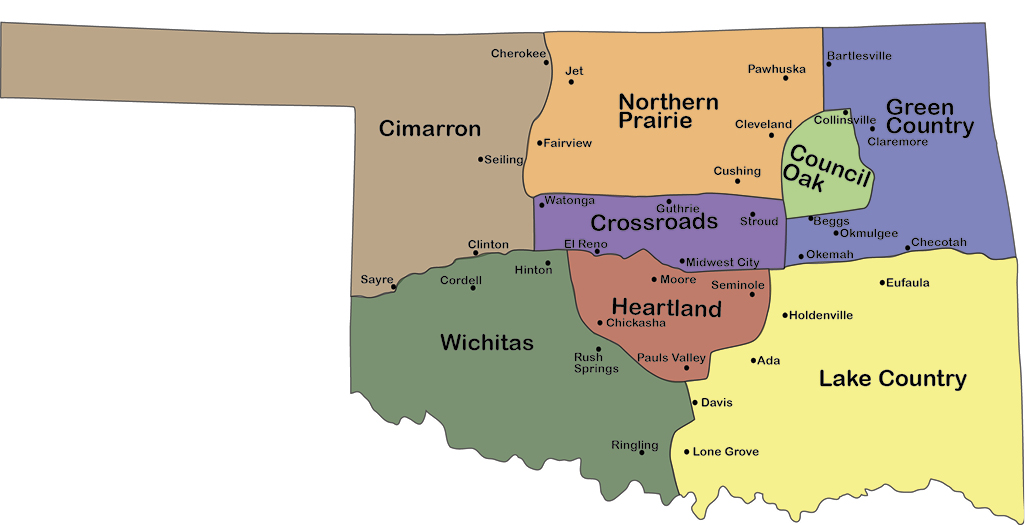
Starting July 1, I'll be the next District Superintendent of the Crossroads District (shown on the map in purple) where Edmond First happens to reside.  This means I'm taking the position of my direct supervisor.  While I will continue to lead through all four components, I will be leaning more heavily on order in this position.  

Our church is one of fifty different congregations that I'll oversee in this post.  I will be traveling each week and it will be my goal to worship in each of our churches within the first calendar year.  My intent is to bring the same joy to this work that I've tried to bring to the local church.  It is a privilege to serve as a pastor and the covenant we keep with the congregation and God is sacred.  As we have been apart during the pandemic, this tie that binds may be more precious than we realized.

I'm excited about the possibilities for ministry that Scott will bring to Edmond.  I'm praying for him during this transition and I would encourage you to do the same.  I'm confident that he'll be uplifted by the generosity of spirit that I've found among the laity of our church!  

My words are inadequate to express my appreciation for our congregation.  I'm looking forward to seeing the work that God continues in this church in the near future!  This Sunday, I'll be preaching on David and Goliath and my sermon title will be "Contending with Giants."  This story is a good reminder that faith helps us face change with courage!

In Christ,

Sam